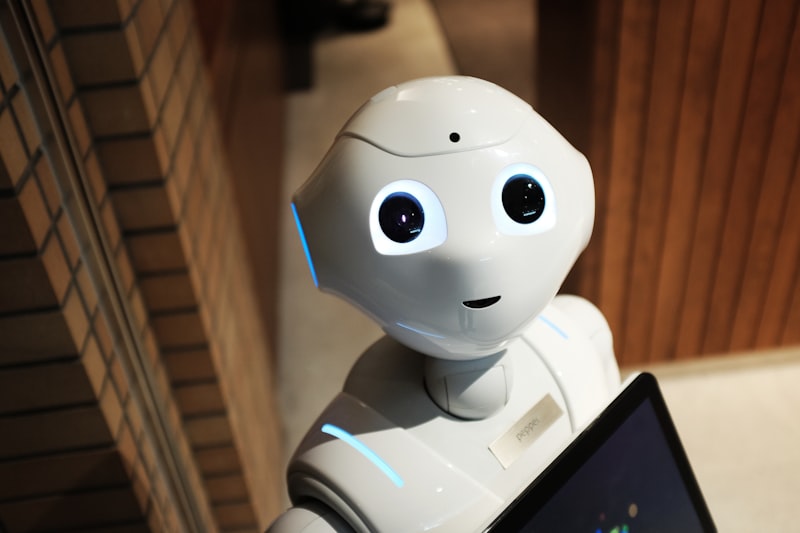
For fifty years, robots lived in cages.
Not metaphorical cages. Literal ones. The industrial robots that built our cars, assembled our electronics, and welded our steel were bolted to the floor, fenced off from humans, and programmed to repeat a single motion thousands of times a day with zero deviation. They were powerful, precise, and completely incapable of handling anything that fell outside their narrow script.
Optimize Your Document Workflow
Boost efficiency and manage files securely with our 100% free online tools. No registration, no watermarks, completely private.
That era is ending faster than almost anyone predicted.
Physical AI is here, and it is teaching machines to do something that was once considered uniquely human: navigate the unpredictable, messy, constantly changing physical world and figure things out on the fly. At CES 2026, the world got its clearest signal yet that humanoid robots are not a science fiction concept with a twenty-year horizon. They are a technology with a deployment roadmap measured in months.
What Physical AI Actually Means
Physical AI is the marriage of advanced machine learning with robotic systems that operate in the real world. It is what happens when you take the reasoning capabilities that have transformed software and give them a body.
The distinction matters enormously. Software AI operates in a controlled environment where the inputs are clean, the rules are consistent, and mistakes are recoverable. Physical AI operates in warehouses where boxes are stacked at unexpected angles, on construction sites where the terrain changes daily, in hospitals where hallways are crowded and no two patient rooms are identical. The physical world does not give you clean inputs. It gives you chaos, and Physical AI has to handle it in real time.
This is why building capable robots has been so hard for so long. The core challenge was never mechanical. Building an arm with the range of motion of a human shoulder is a solved engineering problem. The challenge was intelligence — giving a robot the perceptual and reasoning capabilities to understand what it is looking at, decide what to do about it, and execute that decision with the kind of fluid adaptability that humans take for granted.
The AI breakthroughs of the past three years have cracked that problem open.
CES 2026: The Moment the Industry Declared Itself Ready
Consumer Electronics Show has always been a stage for concept products and aspirational demos that disappear quietly six months later. CES 2026 felt different.
The wave of humanoid robot demonstrations at the show was not populated by prototype machines performing carefully rehearsed tricks on controlled stages. Company after company presented robots operating in realistic conditions, handling variability, recovering from disruptions, and performing tasks with a fluidity that previous generations of robotics simply could not match.
Boston Dynamics commanded the most attention. The company unveiled its electric Atlas — a full departure from the hydraulic systems that powered previous versions and a statement of intent about where the technology is headed. Electric actuation means quieter operation, more precise control, longer operational windows, and dramatically simpler maintenance. The hydraulic Atlas was an extraordinary engineering achievement. The electric Atlas is a commercial product.
The announcement that stopped the room was Boston Dynamics confirming a partnership with Google DeepMind to integrate Gemini Robotics models into its systems. This is not a research collaboration. It is the explicit combination of the world’s most sophisticated physical robotics platform with one of the most capable AI reasoning systems ever built. The implications of that pairing are difficult to overstate.
Why the Boston Dynamics and Google DeepMind Partnership Changes Everything
To understand why this partnership matters, you have to understand what has been missing from robotics until now.
Robots have historically been programmed. A human engineer specifies every motion, every decision point, every response to every expected condition. This works beautifully in controlled environments with predictable inputs. It fails the moment something unexpected happens, and in the real world, something unexpected is always happening.
What Gemini Robotics brings to the partnership is the ability to reason about novel situations. Rather than following a decision tree that a human engineer anticipated in advance, a robot integrated with a powerful language and vision model can look at a situation it has never encountered, reason about what it is seeing, draw on broad knowledge about how objects, spaces, and tasks work, and generate an appropriate response on the spot.
This is the difference between a robot that can unpack a box if the box is exactly the right dimensions in exactly the right position and a robot that can unpack whatever box is in front of it, even if it is dented, mislabeled, and tilted at a thirty-degree angle. The first robot is a very expensive piece of fixed automation. The second one is genuinely useful.
The integration of foundation models with physical robotic systems is the unlock that the entire industry has been waiting for. Boston Dynamics and Google DeepMind doing it together, with the resources and technical depth both organizations bring, makes CES 2026 a genuine inflection point rather than just another trade show.
Where Humanoid Robots Are Being Deployed Right Now
The commercial rollout is not waiting for the technology to be perfect. It is happening now, in specific environments where the economics and the capability requirements align.
Automotive manufacturing. BMW, Mercedes-Benz, and several other major automakers have publicly announced humanoid robot pilot programs on their production lines. The appeal is straightforward: factories are already designed for human-shaped workers. The tooling, the workstations, the physical layout — all of it assumes a body with two arms, two legs, and a head at a specific height. A humanoid robot can slot into that environment without rebuilding the facility.
Logistics and warehousing. The e-commerce explosion created an enormous demand for labor in distribution centers that has consistently outpaced supply. Humanoid robots are being tested on picking, packing, and sorting tasks, with a particular focus on the irregular and unstructured items that have defeated earlier generations of fixed automation.
Semiconductor fabrication. Several chip manufacturers are piloting humanoid systems for material handling, equipment maintenance support, and the meticulous physical tasks involved in fab operations where human error is costly and precision requirements are extreme.
Retail and hospitality. Early deployments in restocking, inventory management, and facility maintenance are underway at select retailers and hotel groups. These environments reward adaptability over raw speed, which plays to the strengths of current generation humanoid systems.
Hazardous environments. Inspection and maintenance work in environments that are dangerous for humans, including nuclear facilities, offshore platforms, and chemical plants, is an obvious early application where the cost of a robot is easily justified against the cost and risk of human exposure.
The Technical Foundations Driving the Leap Forward
Three converging technical advances explain why humanoid robots are crossing from demos to deployments right now rather than five years from now.
Foundation models trained on massive datasets have given robots something they never had before: broad world knowledge. A robot running a sophisticated vision and language model understands what a door handle is, what the act of grasping means, and what is likely to happen when you push versus pull — not because it was explicitly programmed with those facts but because it learned from the same kind of data that teaches humans.
Simulation-to-real transfer has dramatically accelerated physical training. Robots can now be trained on billions of virtual interactions before ever touching a physical object, with the learned behaviors transferring to real hardware with far less degradation than previous methods allowed. What once required months of physical training can now be accomplished in days.
Improved actuator technology, particularly in electric drive systems, has closed the gap between robotic and human movement quality. The jerky, mechanical motion that signaled “robot” to every observer for decades is giving way to smooth, adaptive movement that reads as genuinely capable rather than merely functional.
The Economic Argument That Is Accelerating Adoption
The case for physical AI in commercial settings is not primarily about replacing workers. It is about accessing capability that does not currently exist at any price.
Labor markets in developed economies are tight across virtually every sector that involves physical work. Manufacturing, logistics, construction, healthcare support, and agriculture all face chronic shortages of workers willing to do the work at wages that keep operations economically viable. Humanoid robots do not solve this by taking jobs. They solve it by doing work that is currently going undone or being done inadequately.
The total addressable market for physical labor replacement and augmentation globally is measured in the trillions of dollars. Even capturing a fraction of that market at the kind of scale that modern manufacturing can support represents one of the largest economic opportunities in the history of technology.
Investors understand this. Funding into humanoid robotics companies has accelerated dramatically in the past eighteen months, with valuations reflecting the belief that the current generation of technology represents a genuine commercial breakthrough rather than another research cycle.
What Physical AI Cannot Yet Do
The demonstrations are impressive. The commercial pilots are real. The limitations are also real, and understanding them matters for anyone building deployment plans.
Dexterity remains the hardest unsolved problem. Human hands are extraordinary instruments capable of tasks ranging from threading a needle to carrying a loaded tray. Current humanoid systems are making rapid progress on manipulation but still struggle with the fine motor tasks that humans perform without conscious thought. Applications requiring precise assembly of small components or delicate handling of fragile objects remain at the frontier of what is deployable today.
Battery life and energy density constrain operational windows. Most humanoid robots currently operate for one to four hours before requiring recharge or battery swap, which limits their utility in continuous operation environments. This is an active engineering focus across the industry and will improve, but it is a real constraint today.
Edge cases in unstructured environments are still failure points. A robot that performs beautifully in a logistics warehouse can be completely disrupted by a spilled liquid, an unexpected obstacle, or an unfamiliar object. Robustness to genuinely novel situations in genuinely unpredictable environments is better than it has ever been and still short of what full commercial deployment across diverse real-world settings requires.
The Road Ahead
The trajectory is clear even if the exact timeline involves genuine uncertainty. Physical AI and humanoid robots are moving along the same adoption curve that every transformative technology follows: from expensive, limited, research-stage systems to increasingly capable and cost-competitive commercial products to commoditized infrastructure that reshapes entire industries.
We are currently somewhere between the second and third stages of that curve. The technology works. Commercial deployments are generating real data and real learnings. Costs are falling as manufacturing scales. The gap between what robots can do in a controlled demo and what they can do in a real operating environment is narrowing with each product generation.
Boston Dynamics with Google DeepMind. A wave of humanoid demos that looked like the future being demonstrated as the present. Electric Atlas. Gemini Robotics. CES 2026 was not a preview of what is coming.
It was the announcement that it is already here.
The machines are leaving the cage. What they do next will reshape the physical economy as profoundly as software reshaped the digital one.